
Quick answer
What is the safest way to pay for a streaming subscription?
A credit card is usually the safest choice, followed by a debit card or PayPal using “goods and services”. These give you routes to get your money back if the service is not provided. Avoid gift cards, cryptocurrency and bank transfers to personal accounts, which offer almost no protection.
When you pay for any subscription online, the payment method matters as much as the provider. The right choice can mean the difference between getting your money back in a few days and losing it for good. Here is how the main options compare for UK customers.
Payment methods compared
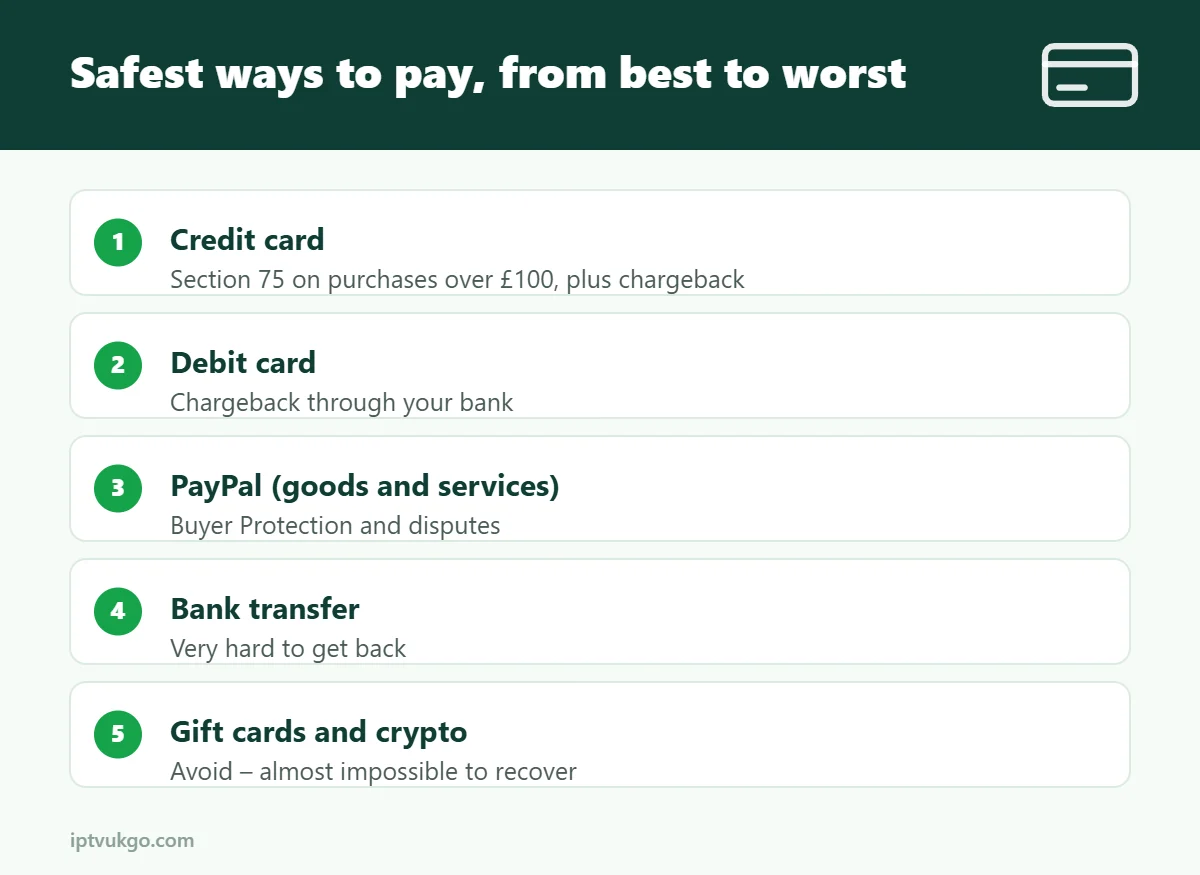
| Method | Protection level | Why |
|---|---|---|
| Credit card | High | Section 75 protection on purchases over £100, plus chargeback |
| Debit card | Good | Chargeback through your bank if the service is not provided |
| PayPal (goods and services) | Good | PayPal Buyer Protection and dispute process |
| Apple Pay / Google Pay | Same as the card behind it | Uses your underlying card’s protection |
| Bank transfer | Low | Very hard to reverse once sent |
| Gift cards / vouchers | Very low | Almost impossible to recover |
| Cryptocurrency | Very low | Payments cannot be reversed |
Credit cards: the strongest protection
Under Section 75 of the Consumer Credit Act, if you pay for something costing between £100 and £30,000 on a credit card, the card company is jointly responsible with the seller. If the service is not provided or is misdescribed, you can claim from your card provider. For smaller amounts, chargeback (see below) still applies.
Debit cards and chargeback
Chargeback is a scheme run by Visa, Mastercard and American Express that lets your bank ask for money back from the seller’s bank when something goes wrong – for example, if a service is never delivered or the company disappears. It is not a legal right, and there are time limits, so contact your bank as soon as you notice a problem.
PayPal
Paying through PayPal using “goods and services” gives you access to PayPal’s Buyer Protection and dispute process. Never agree to send money as “friends and family” to a business – that option is designed for personal payments and removes your protection.
Payment methods to avoid
- Gift cards and vouchers – a common scam request. Once the code is shared, the money is gone.
- Cryptocurrency – transactions cannot be reversed and sellers are hard to trace.
- Bank transfer to a personal account – legitimate businesses rarely ask for this.
- Card details sent by message or email – never type your full card number into a chat.
Other habits that keep you safe
- Start with a short plan. Pay for one month first, then move to a longer plan once you are happy.
- Check renewal terms. Know whether your plan renews automatically, and how to cancel.
- Keep records. Save receipts, emails and messages in case you need to make a claim.
- Use a free trial first. Our 24-hour free trial needs no payment details at all.
- Look for warning signs. Our guide on how to spot an IPTV scam covers the common tricks.
If something goes wrong
- Contact the provider first and keep a copy of your message.
- If they do not respond or refuse to help, contact your card provider or PayPal straight away.
- Explain what you paid for, when, and what went wrong, and send your evidence.
- If you think you have been defrauded, report it to Action Fraud.
Frequently asked questions
Is it safe to pay for IPTV with a debit card?
Generally yes, with a genuine business. Debit cards are covered by chargeback, though credit cards give stronger protection for larger amounts.
Does Section 75 apply to monthly subscriptions?
Section 75 applies to single items or services costing over £100. Many monthly payments fall below that, but chargeback can still help.
Why do some sellers only accept crypto or gift cards?
Because the payments cannot be reversed. That is a strong reason to avoid them.