
Quick answer
Is IPTV legal in the UK?
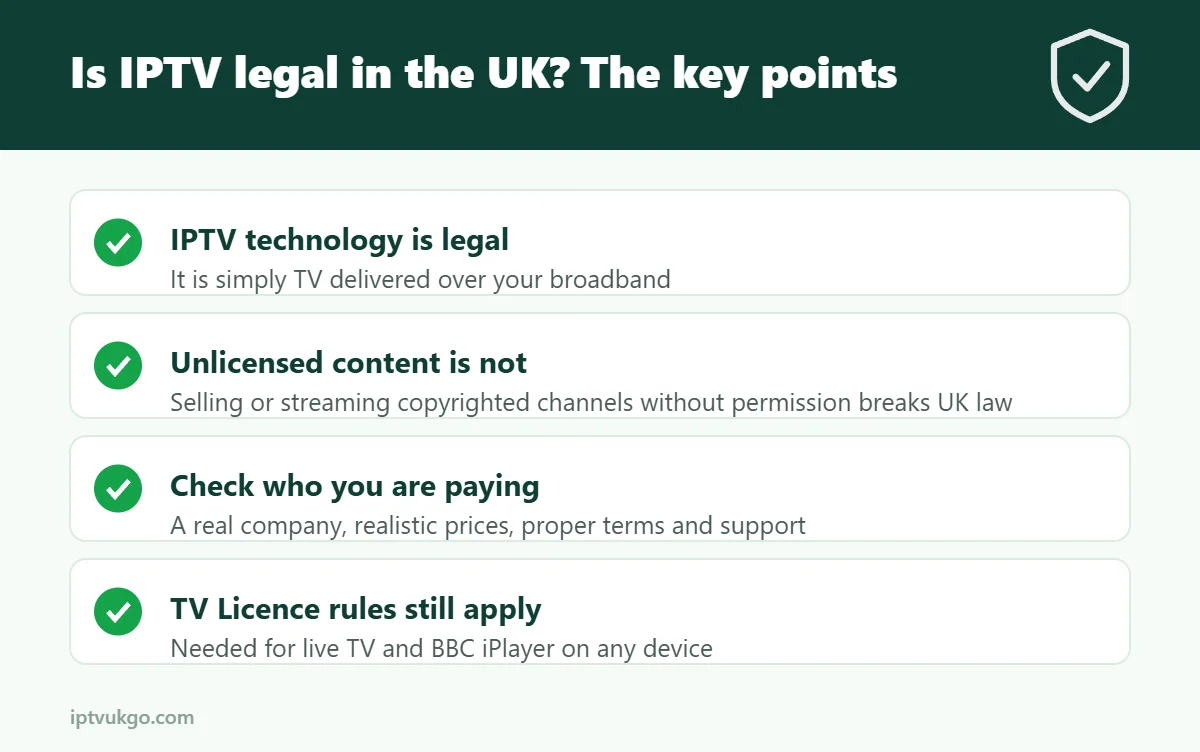
Yes – IPTV itself is legal. It is simply a way of delivering TV over the internet, and services like BBC iPlayer, Sky Stream and Virgin Media’s streaming boxes all use it. What is illegal is watching or selling content without permission from the people who own it. The key question is never “is IPTV legal?” but “is this particular service licensed?”
Search for IPTV in the UK and you will quickly find conflicting answers. Some websites say it is completely legal, others say you could be prosecuted for using it. Both are partly true, because the word “IPTV” describes the technology, not the service. This guide explains the difference in plain English, so you can make a safe, informed choice.
IPTV is a technology, not a type of service
IPTV stands for Internet Protocol Television. It means TV pictures are sent to your home over a broadband connection instead of through an aerial, a satellite dish or a cable. Nothing about that is unlawful. In fact, a large and growing share of TV in UK homes now arrives this way.
Think of it like a car: driving is legal, but driving a stolen car is not. In the same way, watching TV over the internet is legal, but watching programmes that have been copied and redistributed without permission is not.
If you are new to the subject, our guide to what IPTV is explains how it works.
When IPTV becomes illegal
In the UK, TV programmes, films and live sport are protected by copyright. Broadcasters pay a lot of money for the right to show them. A service breaks the law when it takes those channels or programmes and resells them without permission.
UK law treats this seriously. The Copyright, Designs and Patents Act 1988 covers copying and sharing protected content, and since the Digital Economy Act 2017 the maximum sentence for large-scale online copyright infringement has been up to ten years in prison. Most court cases so far have targeted the people running and selling unlicensed services. However, organisations such as FACT (the Federation Against Copyright Theft) have also contacted viewers of illegal services, and people who resell access or “fully loaded” devices have been prosecuted.
Is it illegal to watch, or only to sell?
The clearest legal risk is for anyone who sells, supplies or advertises access to unlicensed content. For viewers, the position is less often tested in court, but that does not make it safe. Watching live TV through an unlicensed stream can still break the law, and there are other risks too:
- Your payment and personal details go to an anonymous seller with no consumer protection.
- Malware is common in unofficial apps and modified “loaded” sticks.
- Services disappear without warning, often after taking a year’s payment in advance.
- No refunds or support when things stop working.
How to tell if an IPTV service is likely to be legitimate
There is no single official list, but genuine businesses tend to share the same signs:
- A real company behind it – a clear business name, contact details, terms and conditions, a privacy policy and a refund policy.
- Realistic prices – no one can legally offer every premium sports and film channel for a few pounds a month.
- Normal ways to pay – card payments or recognised payment services, rather than gift cards, crypto or a bank transfer to a personal account.
- No “fully loaded” devices – legitimate services do not sell pre-programmed sticks or boxes.
- Clear support – a way to reach a real person who answers questions before you pay.
Our article on how to spot an IPTV scam goes through the warning signs in more detail.
Do you need a TV Licence for IPTV?
Yes, in most cases. In the UK you need a TV Licence to watch or record any programme as it is being broadcast live, on any channel, through any service and on any device – including IPTV apps on a Fire Stick, Smart TV, phone or laptop. You also need one to use BBC iPlayer. Read our guide: do you need a TV Licence for IPTV?
What about VPNs?
A VPN can help with privacy on public Wi-Fi, and some people use one to reduce buffering if their broadband provider slows video traffic. But a VPN does not make an unlicensed service legal. If the content is not licensed, hiding your connection does not change that.
The bottom line
- IPTV, the technology, is completely legal in the UK.
- Watching or selling copyrighted channels without permission is not.
- Choose a service that is open about who it is, charges realistic prices and gives you proper terms, support and safe payment options.
- Remember the TV Licence rules apply to live TV whatever device you use.
If you want to try a service before you commit, a free trial is the safest way to check quality and support without paying anything.
Frequently asked questions
Is IPTV legal in the UK?
The technology is legal. Whether a particular service is legal depends on whether it has permission to show the channels and programmes it offers.
Can I get in trouble for watching illegal IPTV?
Prosecutions have mostly targeted sellers and suppliers, but viewers have been contacted by anti-piracy organisations, and watching unlicensed streams can still break the law. It is not worth the risk.
Are Fire Sticks illegal?
No. Amazon Fire TV Sticks are legal devices sold in shops across the UK. What can be illegal is a stick that has been “loaded” with apps that stream unlicensed content.
Are IPTV player apps legal?
Yes. Player apps such as IPTV Smarters or TiviMate are legal pieces of software. They do not include any channels; they simply play the service you sign in with. Read what an IPTV player is.
Does a VPN make IPTV legal?
No. A VPN changes how your connection is routed, not whether the content is licensed.
Sources and further reading